
What is self-service for hotel reservations?
Self-service for hotel reservations means that guests and bookers manage parts of their reservation themselves in an online environment, without an employee having to process every step. The hotel sets the rules and maintains control. Self-service offers the greatest time savings for group reservations, as these typically involve the most emails, guest lists, and changes.
What can you read on this page?
- What "self-service" in a hotel actually means
- Why more and more hotels are offering it
- Which parts of a reservation guests can handle on their own
- How self-service works for group reservations
- What benefits it brings to your team and to the person making the reservation
- Which processes you shouldn’t fully automate
What does "self-service" mean in a hotel?
Self-service in a hotel means that the guest or person making the reservation performs tasks themselves that were previously handled by the front desk or the reservations department. This can be done online, such as modifying a reservation, or at the hotel itself, such as checking in at a kiosk. This page focuses on self-service related to reservations: everything that happens between the initial request and arrival.
The key feature is that the guest enters the information themselves, while the hotel sets the parameters. The hotel determines in advance which rooms and rates are available and the deadline for making changes. The guest operates within those parameters.
Why do hotels offer self-service?
Hotels offer self-service because guests ask for it and because it saves the team a lot of time. Guests are used to handling things online themselves. In the “Hospitality in 2025” survey of more than 5,000 travelers worldwide , 73%said they are more likely to choose a hotel that offers self-service technology. A study by Mews paints a similar picture: nearly 80% of travelers want to stay at a hotel with an automated front desk or self-service options.
For the team, the main benefit is the time saved. A large part of the reservation work involves entering data from emails and answering frequently asked questions. If guests enter that information themselves, no one has to retype it, and the chance of errors decreases. For hotels with a small reservations department, self-service is a way to offer the same level of service with less workload.
Also read about where you lose the most time in your group reservation process.
Which parts of a reservation can guests handle on their own?
Guests can handle almost everything on their own when it comes to providing information or choosing from set options. Common examples include:
- making a reservation or submitting a request
- entering personal information and arrival time
- providing room assignments and names
- selecting extras, such as breakfast or parking
- notifying the property of a change or cancellation in accordance with the terms and conditions
- Pay online in advance or make a deposit
In cases of exceptions or negotiations, a staff member will remain involved. Further on, you’ll read about which processes you should avoid fully automating.
Is self-service also available for group reservations?
Yes. Self-service actually works well for group reservations, because that’s where the most disparate pieces of information need to be brought together. For a group of twenty rooms, there are quickly dozens of names and arrival dates, which usually come in scattered across emails and spreadsheets.
With self-service, the organizer or individual guest enters that information themselves in an environment set up by the hotel. The reservations department sees everything in one place and only needs to verify and confirm.
Bookers are also increasingly expecting this. According to Cvent’s Planner Sourcing Report 2026, 86% of planners are more likely to choose a venue that offers online booking for a simple meeting.

What are the benefits for hotel employees?
The biggest advantage is that employees spend less time retyping and following up by phone. Data is received immediately in the correct format, which reduces errors in names or dates. This cuts down on corrections later on and prevents unpleasant surprises upon arrival.
For a reservations agent, this means a less cluttered inbox and a clearer overview. A reservations manager can more easily track the status of requests and options. For the general manager and the owner, the key benefit is that the team can process more requests without hiring additional staff, and that requests receive quotes more quickly.
Want to know how to quantify these benefits? Read about which KPIs to track for group reservationsat or see how a smarter group booking process benefits hotels.

What are the benefits for the person making the reservation?
The booker is the person or organization that organizes the group, such as a travel agency, a sports club, a school, or a company. For the booker, self-service means, above all, speed and clarity.
- Submit a request immediately, even in the evening or on the weekend.
- Receive a quote faster, so the booker can make a decision sooner and secure an option.
- Always see where things stand, with the request status and deadlines all in one place.
- Fill out the list of names yourself or let participants enter their own information, instead of sending spreadsheets back and forth.
- Submit changes yourself as soon as they’re known.
- Work with a single, up-to-date list that the hotel can also view, ensuring there are no surprises upon arrival.
Speed is particularly important to bookers. According to Cvent , 80% of plannersconsider a response time of four days or less to be ideal, and 62% of requests go to one of the first three venues to respond. A hotel that lets the booker submit a request directly and sends a quote quickly is therefore more likely to be among those first to respond.
Does self-service affect the guest experience?
Yes, and usually in a positive way. Guests get a response faster and can see for themselves what’s been arranged. For a group organizer, it also saves a lot of back-and-forth emailing.
Self-service only works well, though, if it’s simple and the guest knows they can still reach someone. An environment that’s unclear or no longer allows for personal contact can quickly feel distant. The best approach combines convenience for the guest with a dedicated point of contact at the hotel. That way, your team has time left over for the personal touch that guests ultimately use to judge a hotel.
Which hotel processes should you avoid fully automating?
It’s best not to fully automate processes where judgment or personal attention is key. Examples include:
- price agreements with large or strategic groups
- exceptions to cancellation policies
- complaints and situations where something went wrong
- special requests regarding accessibility or health
- the welcome upon arrival
A good rule of thumb: let the guest fill in what’s already set in stone, and let your team decide where there’s room for flexibility. Self-service eliminates routine tasks, giving your team more time for these moments. In Step 4 of our roadmap for a better group booking process, you’ll learn how to make that distinction.
Self-Service for Group Reservations
Group reservations are the area of hotel reservations where self-service offers the greatest benefits. Groupz is group reservation software designed for hotels and group accommodations. Groupz works alongside your existing PMS and supports every aspect of the group reservation process, from the initial request to arrival.
Why Group Reservations Are Different
An individual booking is usually completed in just a few clicks. A group reservation involves multiple rooms, varying arrival dates, a reservation hold period, deposits, and a guest list that keeps changing right up until arrival. At many hotels, this is still handled via email and Excel. Every change means retyping everything, and the big picture is often only in the head of a single employee.
This has consequences. According to an analysis by Groups360 , on average only about 45% of group requestsreceive a response from the hotel. Every request that goes unanswered represents revenue that goes to another hotel.
How Self-Service Works for Group Reservations
- The person making the reservation submits a group request via an online form on the hotel's website.
- The hotel receives the request in a clear, organized format and quickly sends a quote based on pre-set rates and terms.
- The booker accepts the quote online, securing the reservation immediately.
- The organizer fills out the rooming list themselves or has participants enter their own information.
- Deadline reminders are sent automatically, so no one has to chase down the guest list.
- Changes are made within the same system, ensuring the hotel always works with the most up-to-date list.

What the organizer handles themselves
The organizer submits the request, accepts the quote, provides names and room assignments, and reports any changes. This can be done at any time, without waiting for a response via email.
This has consequences. According to an analysis by Groups360 , on average only about 45% of group requestsreceive a response from the hotel. Every request that goes unanswered represents revenue that goes to another hotel.
What the hotel controls
The hotel determines availability and prices, sets the terms and conditions—such as option periods and the deadline for the guest list—decides on exceptions, and remains the personal point of contact for the group. So the hotel retains control. Only the task of entering data shifts to the booker.
What it yields per roll
- Reservations Agent: No more retyping lists of names from emails, and fewer errors upon arrival.
- Reservations Manager: A single overview of all group requests, options, and deadlines.
- General Manager: Faster quotes and increased group revenue without additional staff.
- Owner or hotel operator: a group booking process that doesn’t depend on a single person and grows along with the business.
- Booker: Faster clarity and the ability to manage names and changes independently.
Does the self-service feature for groups work alongside your PMS?
Yes. Your PMS remains the central system for rooms, availability, and the final reservation. The related tasks—such as quotes, guest lists, and changes—often take place outside the PMS. That’s where Groupz comes in. Learn more about where your PMS ends and Groupz begins.

Frequently Asked Questions About Self-Service Hotel Reservations
Online booking is one aspect of self-service. With self-service, guests also handle the steps that follow the booking, such as providing additional information or requesting a change. For groups, this also includes the guest list and room assignments.
Yes. Small hotels, in particular, save time this way, because employees there often wear multiple hats. You don’t have to automate everything at once. Start with the area that’s currently taking the most time. With the Groupz QuickScan, you can see where that time is being spent in just two minutes.
No. Groupz works alongside your existing PMS. Most tasks related to group reservations—such as quotes, follow-ups, and guest lists—take place outside the PMS. Learn more about the difference between Groupz and your PMS.
A rooming list is a list of names for a group, showing who is staying in each room and when. With self-service, the organizer or participant fills out the list online themselves, so the hotel doesn't have to copy lists from emails.
Set a fixed deadline and have the system send automatic reminders. That way, no one has to follow up on the list, and the hotel can immediately see which details are still missing.
Yes. The hotel sets the rates, availability, and terms and conditions in advance. The person making the reservation can only operate within those parameters. Exceptions and special arrangements must always be handled by a staff member.
As soon as possible, and preferably within four days. For smaller groups, the bar is set higher: according to Cvent ,39% of planners for events with up to 50 people will rule out a venue that doesn’t respond within two days. With preset rates, a quote can be sent out much faster.
That depends on the size of your hotel and the number of groups. Check out Groupz's rates or compare hotel group reservation software.
Wondering how self-service for groups can benefit your hotel?
Discover where opportunities lie within your current group booking process in less than two minutes with the Groupz QuickScan.
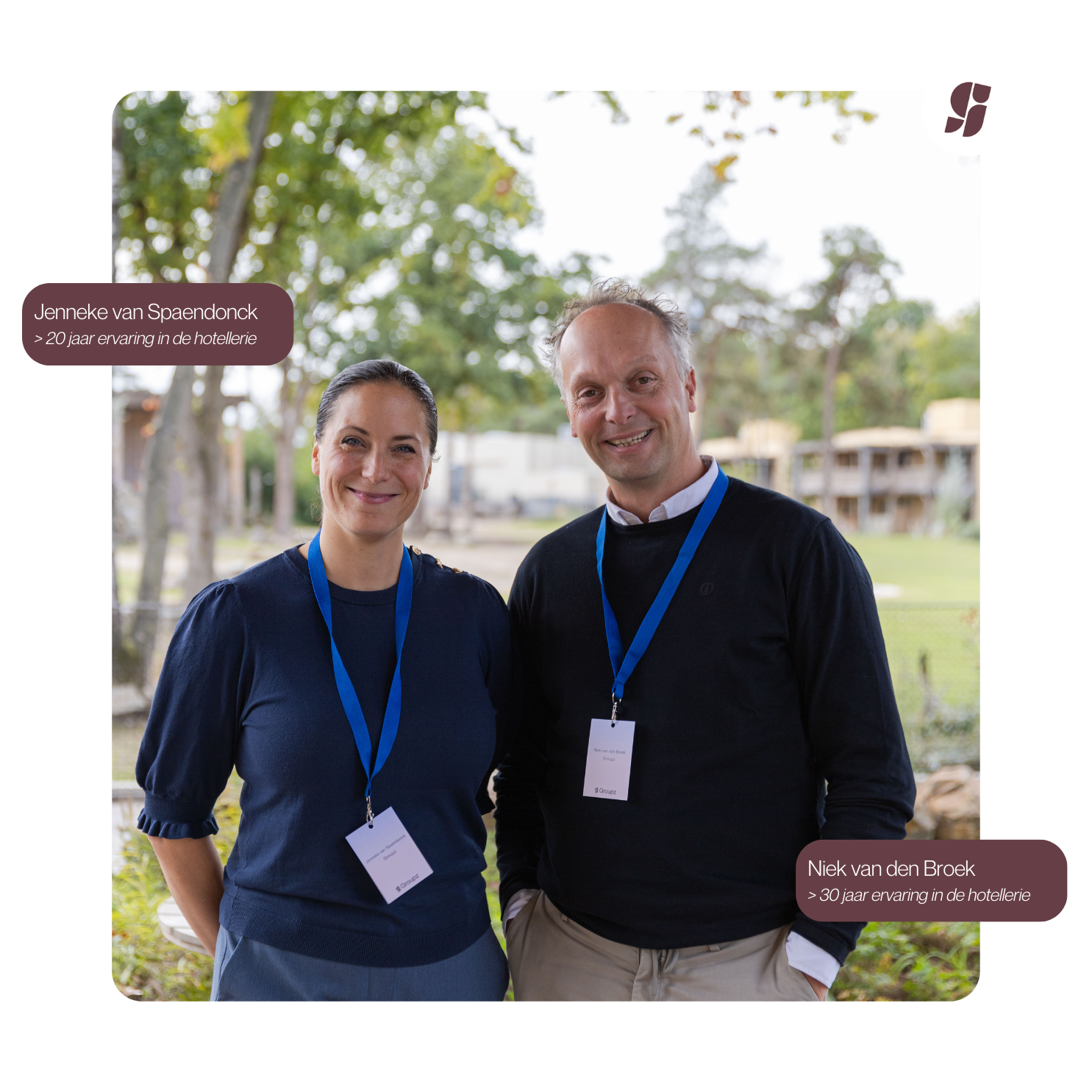
Or would you like to see how it works right away? Check out how Groupz works or schedule a no-obligation consultation with Jenneke or Niek.

Product & Operations Manager
Easily schedule an appointment with Jenneke

Hotelier & Founder