
Automation offers your hotel more benefits than hiring additional staff once your reservations team is spending a lot of time on repetitive tasks, such as preparing quotes and following up on requests. Hiring additional staff is particularly worthwhile when the number of group reservations is growing steadily and your team is already using its available time efficiently.
The number of group reservations is growing, the workload on the reservations department is increasing, and staff barely have time for their other duties. Is it time to hire an additional colleague? Or is there still plenty of capacity to be freed up within the existing team?
This is a familiar challenge for many hotels. More requests mean more quotes, communication, changes, and administrative tasks. And while hiring additional staff seems like a logical solution, it’s wise to first investigate exactly where the workload is coming from.
After all, how much time does your team actually spend on guests and business opportunities? And how many hours are wasted on tasks that could be automated?
When is hiring additional staff the right choice?
Growth requires capacity—especially when a hotel consistently receives more group requests, the number of events increases, or commercial ambitions expand.
Hiring additional staff can then be a wise investment. For example, when:
- The number of group reservations is consistently growing. Your team is handling more requests and doesn’t have enough time to properly follow up on every commercial opportunity.
- Personal attention is under pressure. Staff members have too little time to advise guests, maintain relationships, and handle complex requests.
- The scope of work is expanding. Think of larger events, complex packages, or more customized services for corporate groups.
- Staffing is vulnerable. In the event of illness, vacation, or staff turnover, backlogs arise immediately because too many responsibilities rest on a single employee.
In these situations, expanding the team can contribute to a better guest experience, higher conversion rates, and further growth. However, there’s an important question you, as a hotel manager, must answer first: where is the available work time currently being spent?
When does a process issue resemble a staffing shortage?
Suppose your reservations department receives dozens of emails daily about group bookings. Employees answer the same questions, manually prepare quotes, check availability, and process changes in various systems.
As the number of requests rises, so does this administrative burden. The result? Employees feel overwhelmed, quotes take longer to process, and guests have to wait for a response.
It’s tempting to think that more staff are needed. But if a large portion of the workday is spent on repetitive tasks, hiring an additional employee simply perpetuates the existing inefficiency.
Here are some signs that the workload stems from the process itself:
- Data is entered manually multiple times.
- Employees search for information in various email inboxes and documents.
- Quotes and confirmations are manually drafted over and over again[Jv1] .
- Follow-up on requests depends on manual reminders.
- Employees spend time on checks that often do not require follow-up action, such as verifying whether a payment has already been received.
- It is difficult to track the progress of group bookings.
- New employees need a lot of training before they can process bookings independently .
Do you recognize several of these signs? If so, it’s wise to first take a close look at the group reservation process.
Structural growth or inefficiency: how do you tell the difference?
An increase in the number of group reservations almost always means more work. But the amount of extra work doesn’t necessarily have to grow proportionally. To determine whether you need more staff, it helps to compare two figures: the number of group reservations and the average processing time per reservation.
Suppose your hotel processed 100 group reservations per month last year. That number has now risen to 150—a 50% increase. If each group reservation takes an average of three hours to process, the monthly time spent goes from 300 to 450 hours.
But what happens when you reduce that processing time to an hour and a half by automating (part of) the process and minimizing manual tasks?
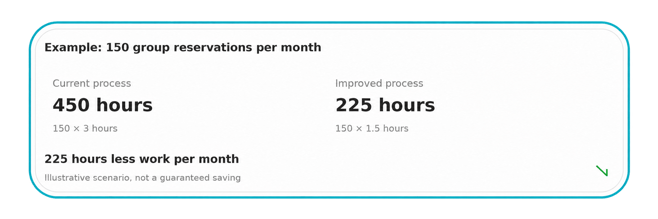
In this example, the same team can therefore process significantly more reservations without a proportional increase in workload. That’s exactly why it’s important to first examine the structure of the process when scaling up.
Which tasks can you automate, and where does personal contact remain important?
Within the group reservation process, there are tasks that take a lot of time but require relatively little human attention. Think, for example, of collecting data, preparing standard quotes, sending confirmations, and following up on requests.
Other tasks, on the other hand, require personal involvement. A guest organizing a multi-day event may need advice on room layout, packages, or specific requests. This is where an experienced reservations agent can provide commercial value.
|
Suitable for automation |
Human attention |
|
Collecting and recording requests |
Evaluating complex requests |
|
Preparing standard quotes |
Providing personalized advice |
|
Sending confirmations |
Negotiating terms |
|
Sending reminders and following up |
Maintaining relationships with bookers |
|
Collecting booking information |
Identifying commercial opportunities |
|
Making information centrally available |
Coordinating special requests |
By automating repetitive tasks, employees gain the time to focus more on requests where their knowledge and experience are most valuable.
This can also have an impact on commercial results. When employees can respond more quickly and have more time for personal contact, they have the capacity to follow up on more requests with greater care.
What is the cost of additional staff compared to automation?
To make an informed decision, you need to understand the financial implications of both options. Hiring an additional employee entails recurring personnel costs, such as salary, employer contributions, onboarding, and potential recruitment expenses. With automation, you’ll face software costs, implementation, and the time required to redesign processes.
The comparison becomes interesting when you calculate how many staff hours you can save through automation. For this calculation, we’ll use an indicative employer cost of €22.20 per hour, based on a reservations clerk in job group VI, pay grade 3 of the Hospitality Collective Bargaining Agreement, including 30% employer contributions.
|
Time Saved |
Per month |
Per year |
|
5 hours per week |
€481 |
€5,772 |
|
10 hours per week |
€962 |
€11,544 |
|
20 hours per week |
€1,924 |
€23,088 |
|
38 hours per week (1 FTE) |
€3,656 |
€43,867 |
Indicative amounts based on €22.20 per hour and 52 weeks per year. Rounded to whole euros. These amounts represent freed-up staff capacity and do not automatically translate to direct cost savings.
A hotel that frees up twenty hours per week through automation thus creates over €23,000 in staff capacity on an annual basis. You can use that capacity to process more requests, improve service, or accommodate growth without immediately hiring additional staff.
How do you create a business case for process automation?
A business case doesn’t have to be complicated. With just a few figures, you can already make a solid initial assessment.
1. Assess your current reservation volume
How many group requests does your hotel receive on average per month? And how many of those actually result in a booking? Ideally, look at a 12-month period so that seasonal trends become apparent.
2. Measure the time spent per request
Track how much time employees spend processing each request. Include the entire process: from the initial request and quote to changes, communication, follow-up, and administrative processing.
3. Determine which tasks can be automated
Identify which tasks are repetitive and how much time they take. Distinguish between tasks that can be fully automated and those where employees can receive support.
4. Calculate the financial value of the hours freed up
Multiply the number of hours you expect to save by the average hourly labor cost.
5. Weigh the benefits against the investment
Compare the value of the freed-up staff hours with the costs of software, implementation, and any additional work.
By “value of freed-up staff hours,” we mean the labor costs you would incur to perform the same work manually. This includes the gross hourly wage, plus employer contributions such as social security premiums and vacation pay. These can significantly increase actual labor costs.
A simple formula: Annual capacity value = hours saved per week × 52 × hourly employer costs
Suppose your hotel saves 10 hours per week and the total employer costs amount to €22.20 per hour. In that case, that freed-up time represents a value of €11,544 per year.
This does not automatically mean you’ll save €11,544 in labor costs. You can also use this capacity to process more group reservations without hiring additional staff.
For a complete business case, you should also consider expected growth, service quality, and the commercial opportunities that arise when employees have more time available.
When does process optimization yield greater returns than hiring additional staff?
Ultimately, the decision comes down to how much extra capacity your hotel needs and how best to organize it. Hiring additional staff makes sense when the workload is increasing on a structural basis and available capacity is already being used efficiently. Process optimization is financially attractive when employees spend a lot of time on repetitive tasks that can be automated.
In practice, a combination of both may be the best choice. By improving the process first, you’ll gain a clearer picture of the staffing capacity you actually need. And you may find that you can continue to grow for years to come with the same team.
Process more group reservations with the same team?
With Groupz, you can automate recurring tasks within the group reservation process—from requests and quotes to communication, follow-ups, and changes. Everything is organized centrally, so employees spend less time on administrative tasks and have more time to focus on guests and business opportunities.
Want to take a closer look at what manual work is costing your hotel? Then read our free white paper on the hidden costs of group reservations.
Frequently Asked Questions About Staffing and Automation in Hotels
Curious about what Groupz can do for your hotel?
In our interactive demo, you’ll discover for yourself how Groupz automates the group reservation process.
Together, we’ll take a look at your current group booking process and identify where the biggest opportunities lie.
Want to find out where you can save time?
Then schedule a free, no-obligation appointment with Jenneke so you can walk through your current situation together.